MUSIC OF THE PLANTS IS NOW PLANT MUSIC

Do you think music can influence the health of trees? Or might loud noise harm them? And could the joyful mood of humans during a festival actually make trees feel “happy”?
Let’s explore the fascinating research of Henk Kieft. During an interview, he told us about his experiment in the city park of Deventer, the Netherlands. Using various methods – including the “Music of the Plants” – he showed that even loud festival noise can, surprisingly, have a positive effect on tree vitality.
Henk Kieft is a Dutch agronomist, specialized in quantum and intuitive agriculture. He introduced the MEI model (Mass, Energy, Information) to expand the understanding of sustainable farming.
Without mass, things are not tangible; without energy mass does not act or move; without information mass and energy have no direction and are useless.
He is the author of Quantum Leaps in Agriculture, where he proposes techniques based on energy and information. It can be downloaded from www.gaiacampus.com He also co-authored Stralende Bomen (Radiant Trees), which explores the energetic field of trees. Kieft co-founded the Forest Healing Foundation in Sri Lanka, dedicated to reforestation and biodiversity.

During the Deventer Festival on August 20, 2016, which takes place in a beautiful urban park filled with centuries-old trees, organizers often received questions about whether the loud music might harm the vegetation.
Due to Kieft’s unique approach to observing trees and plants, he was asked to assess whether the festival music indeed would have negative effects on the trees. It was an intriguing challenge: to his knowledge, no one had ever studied this topic before.
Kieft used three observation methods—an absolute first in this kind of research:
For over 80 years, electrical current in plants has been measured. By connecting a simple voltmeter between root and leaf, one can detect the voltage: weak trees show less than 50–100 mV, while healthy trees exceed 150–200 mV.
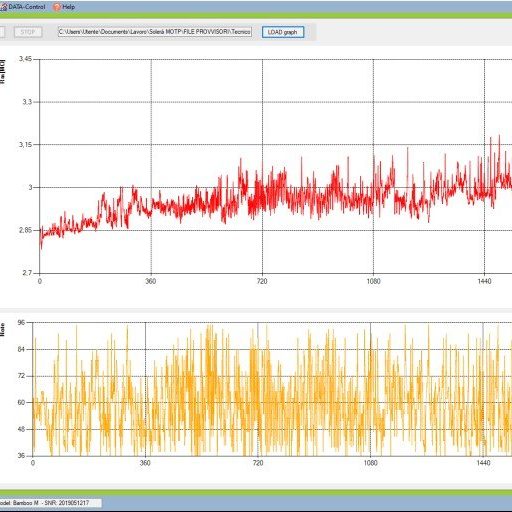
The “Music of the Plants” device converts a tree’s electrical resistance into musical tones. By connecting it to the trunk and a leaf, the active time – when the tree produces sound – can be recorded. The more music it generates, the higher its vitality.
Sensing subtle energy shifts in your hands or chest, it is possible to feel the energy radiating from a tree. A healthy tree emits energy up to the edge of its crown projection on the ground, while a weaker one radiates closer to the trunk.
We selected seven trees located near the five main stages of the festival. Two oaks (EIK) were exposed to the MAIN Stage, one linden tree (LINDE) was near the KIDS zone, two hornbeams (HAAGBEUK) were close to the food area (EETTENT), a maple (ESDOORN) was behind the DANCE stage, and a copper beech (RODE BEUK) behind the TECHNO stage.
We conducted three rounds of measurements during the afternoon, under similar weather conditions (partially cloudy or sunny skies). The measurements were taken:

It has been known for over 100 years that electrical current can be measured in plants. Only in recent years has this phenomenon regained attention, including in agriculture and horticulture.
 But what does this small electric current say about a tree’s vitality? Here, we assume that a tree is more vital when the current is stronger. Think of the sap flows in the trunk: the transport of nutrients from roots to leaves and the distribution of energy from the leaves to the rest of the tree. All of these processes involve electrically charged ions and electrons, thereby generating a current, measurable in milliVolt (mV).
From the measurements we’ve taken so far — and those found in literature and on various websites — we know that weak trees show less than 50–100 mV. In vital and strong trees, we measure values over 150–200 mV, sometimes reaching up to 500 mV. That’s half a Volt — enough to light up a small LED bulb.
We have visualized all these measurements in simple graphs: before, during and after the festival.
Before the festival: both oaks (OAK) were very weak. The linden (3-LINDEN) was in fair condition, and the other four trees were reasonably vital.

During the festival: both oaks (OAK) recovered significantly. The linden (3-LINDEN) also improved slightly. The other four trees near the FOOD AREA, DANCE, and TECHNO zones showed an average drop of 100 mV and thus became weaker.

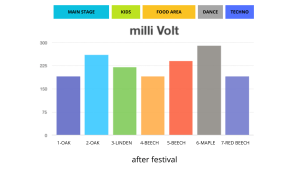
Three days after the festival: vitality was fully restored and even slightly improved.

According to Kieft, the creators of Music of the Plants were looking for a way to perceive a plant or tree not only through sight and touch, but also through hearing. The sense of hearing seems to enter more deepy in our awareness than seeing or feeling. For this reason, they needed a device capable of transforming a signal from the tree into audible sound. The electric current — or more precisely, the tree’s resistance to this current — proved to be the ideal medium for doing so.
From a series of observations, it became clear that a vital tree sends signals more frequently than a weak one. However, even a tree under significant stress can emit many signals, indicating high activity. To assess the influence of music on a tree, it is therefore necessary to compare different times of day or different days. Furthermore, this musical observation should be compared with other vitality or stress measurements. This we did indeed with the three methods applied.
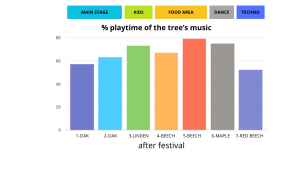
In the city park of Deventer, we compared millivolt measurements and subtle energy perception. We recorded the music of all the trees and timed the length of silent and active moments. The table and graphs report the percentage of time in which the tree produced music, ranging from 43% to 79%. We consider this value as an indicator of the tree’s vitality, as it matches the results obtained with the other two measurement methods. The higher the percentage of music playing, the greater the vitality of the tree.
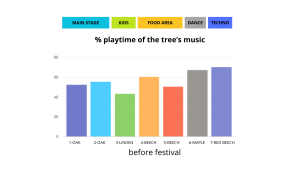
Four days before the festival: all trees were fairly active, especially the maple (6-MAPLE) and the copper beech (7-RED BEECH).
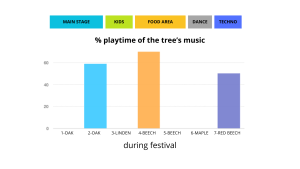
During the festival: we were only able to measure three trees. The oak (2-OAK) maintained its level, a hornbeam (4-BEECH) became 10% more active, while the red beech (7-RED BEECH) dropped by 20%.
Three days after the festival: vitality was fully restored. Only the red beech (7-RED BEECH) still showed some residual effect.
Humans have the innate ability to perceive subtle energies that surround soil, plants, and trees. This sensitivity, often felt through the palms or forehead or in the chest, forms the basis of dowsing, an ancient practice that uses tools like pendulums and rods to measure nature’s vitality.
Farmers and researchers use these techniques to evaluate soil quality or the vitality of agricultural products and food, based on parameters such as Bovis values. More vital soils emit stronger and more easily perceived energy. The methods and background have been described in the book ‘Quantum Leaps in Agriculture’.
Interestingly, no special tools are needed for this research — our bodies are natural detectors. The key is to learn how to interpret these subtle sensations in your body. Learning to listen to them allows us to reconnect directly and deeply with the earth. Because, in doing so, we can gain invisible but valuable information from our surroundings, especially from plants and trees.
E = Energy radiation manually perceived from the trunk
CP = Crown Projection, the projection of the tree’s canopy on the ground
For the interpretation of the sensed energy, we need a reference: this is the crown projection of the tree’s canopy on the ground below the tree.
From numerous observations, we know that a tree is in good health if its energy radiation is perceived right at the edge of its canopy projection. This is referred to as the crown projection (CP). If the canopy is round, its projection on the ground forms roughly a circle.
If the tree’s energy extends beyond the crown projection, we consider this a positive sign (+), indicating a highly vital tree. If the tree is weaker, the radiation is found closer to the trunk, within the CP.
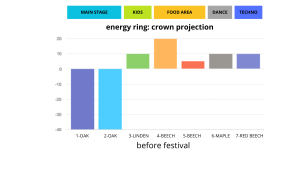
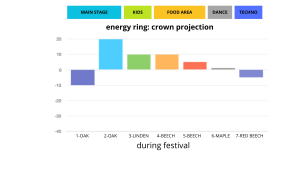
In the graph, these values are shown with a “−” sign (energy within CP) or a “+” sign (energy beyond CP). Values below zero indicate reduced energy, closer to the trunk.
For example:
To provide a quick overview of the data, we present this information in the graphs below.
Four days before the festival: both oaks (OAK) were very weak, while the other five trees were reasonably vital.
During the festival: both oaks (OAK) improved significantly. The other five trees lost on average 1 meter of energy radiation, but remained at an average level of vitality.
Three days after the festival: vitality remained constant or was slightly restored. The maple (6-MAPLE) and red beech (7-RED BEECH) still showed some residual effects.
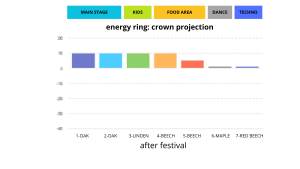
This observation suggests there is no need to offer them regenerative music or other interventions to care for the wellbeing of the trees after the event.
The most important conclusion for organizers—and for tree lovers—is that trees do indeed respond to music, but ultimately they do not become ill, nor do they permanently decrease their vitality.
For researchers, an important takeaway is that the three different observation methods yielded almost identical results.
This conclusion is significant, as it adds confidence to the conclusions of each of the measuring methods. we can now say with some confidence that the influence of music on trees can be measured, to some extent, with very simple methods.
The methods involving electrical tension and plant music are quite objective. Since all three methods provided similar results, this strengthens trust in the unconventional intuitive approach to measuring subtle energies. These are affordable, simple, and accessible methods that anyone can apply. The conclusions can also be improved through more frequent measurements and by observing a tree—or plant—over a longer period and with various music styles. A nice challenge for plant lovers.
However, we also acknowledge that this method needs further refinement. Many open questions remain and deserve deeper exploration.
Do trees respond to music or to the mood of people?
My first response is that musical styles tend to attract people who feel good with that kind of music, so the mood might be less relevant. In that case, trees would respond more to the music than to the audience’s emotions.
However, some experienced festival-goers have pointed out that human mood should not be underestimated, as it may also influence the trees. For instance, techno music, some suggest, may generate or amplify anger in the crowd, broadcasting frustating frequencies, which could disturb the trees. On the other hand, other genres—such as those played on the Main stage—seem to foster calmness and could have a more positive effect on trees.
Many questions remain unanswered scientifically but we suggest some hypotheses:
These questions are an invitation to you, the reader, to experiment for yourself. Some farmers and gardeners already use music to support the vitality of their crops. Agricultural advisor Dr. Yannick van Doorne, active in France and Belgium, works extensively with music. To support plants, he recommends baroque music with rhythms of 60 to 72 beats per minute, and if possible, tuned to 432 Hz.
This type of music has proven highly effective in improving the health and growth of plants.
We sincerely thank Henk for this incredible research contribution to our understanding of communication with the plant world.
Henk Kieft

Receive DISCOUNT CODES, useful information and extraordinary experiences joining our newsletter.